
What is a sequence timer?
A sequence timer is an electrical control device that activates connected outputs in a defined order and at configured time intervals. Its functions depend on the model and application.
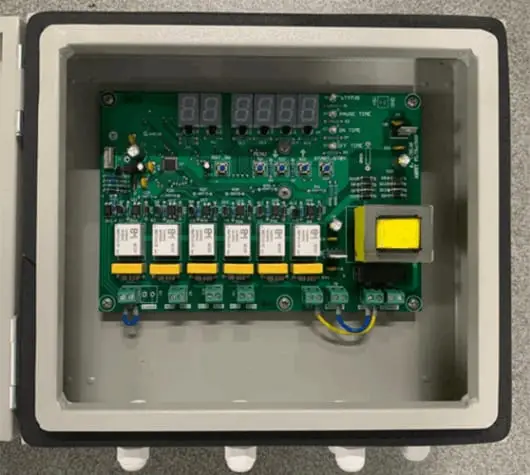
Dust Collector
Sequence Timer Manufacturer
A sequence timer controls the timing and order of connected operations in compatible industrial systems. In pulse-jet dust collectors, it can activate solenoid valves sequentially to release compressed-air pulses for filter bag cleaning. Selection depends on output configuration, supply voltage, timing settings, operating environment and system compatibility.
A sequence timer is an electrical control device that manages the order and timing of operations in a connected system. It activates outputs according to a configured sequence, allowing equipment to perform repeated operations at specified intervals without requiring each operation to be triggered manually.
In industrial dust collection, sequence timers are commonly associated with pulse-jet cleaning systems. These systems use compressed-air pulses to remove accumulated dust from filter bags. The sequence timer controls the activation of the connected solenoid valves so that the filter bags are cleaned one after another according to the configured settings.
The timer's purpose is to coordinate the cleaning cycle. Its performance depends on the controller design, electrical connections, timing parameters and compatibility with the dust collector.
A pulse-jet dust collector uses filter bags to capture airborne dust from an industrial air or gas stream. As dust accumulates on the filter media, the resistance to airflow may increase. A cleaning mechanism removes accumulated dust to help maintain the filtration system's operation.
A sequence timer coordinates this cleaning process through several steps:
1. Timing configuration: The required operating intervals and pulse duration are configured according to the controller's capabilities and equipment requirements.
2. Output activation: The timer activates a designated output connected to a compatible solenoid valve.
3. Compressed-air pulse: The valve releases compressed air through the cleaning arrangement to dislodge accumulated dust from the corresponding filter bag.
4. Sequential operation: The timer activates the next output according to the programmed sequence.
5. Repeated cleaning cycle: The sequence continues according to the configured operating logic.
The exact operation varies by timer model and dust collector design. Some systems also use differential-pressure controls or other signals to manage when cleaning starts and stops.
The timer activates connected outputs in a defined order. In a pulse-jet dust collector, these outputs may control the solenoid valves responsible for filter bag cleaning.
Depending on the model, a sequence timer may provide adjustments for pulse duration, interval between outputs or other timing functions. The available settings must be confirmed from the product documentation.
By coordinating valve activation, the timer helps automate repetitive cleaning operations and reduces the need for manual triggering of each pulse.
A compatible timer can operate as part of a dust collector's electrical control system. Wiring, output type, voltage and current ratings must match the connected components.
The required sequence and timing depend on the number of outputs, solenoid valve arrangement and cleaning requirements of the dust collector.
Sequence timers are used in different automated systems. In industrial filtration, relevant applications may include:
Pulse-jet dust collectors: Sequential activation of cleaning valves for filter bags.
Baghouse filtration systems: Coordination of cleaning operations across multiple filter rows or compartments, where supported by the control design.
Industrial dust extraction: Timing control for compatible compressed-air cleaning arrangements.
Manufacturing automation: Sequential control of connected equipment where the timer's functions meet the application requirements.
Other industrial control systems: Repetitive timed operations involving compatible electrical outputs.
The suitability of a particular timer depends on its design and electrical specifications. A timer intended for one control application should not automatically be assumed suitable for every industrial system.
Selecting a sequence timer requires checking the control system requirements rather than choosing a device based on its name alone.
1. Number of outputs: Determine how many solenoid valves or other devices must be controlled. The timer must support the required number of outputs.
2. Supply voltage: Confirm the timer's required input voltage and compatibility with the available electrical supply.
3. Output specifications: Check output type, voltage and current ratings against the connected solenoid valves or control components.
4. Timing range: Verify that the available pulse-duration and interval settings meet the equipment's operating requirements.
5. Operating mode: Confirm whether the timer supports the required sequence, cycle and triggering behaviour.
6. System compatibility: Check compatibility with the dust collector's control panel, solenoid valves and any connected pressure-based control system.
7. Operating environment: Consider temperature, humidity, dust exposure and enclosure requirements at the installation location.
8. Installation requirements: Confirm mounting arrangement, terminal connections, wiring requirements and the available space in the control panel.
Providing these details before purchasing helps reduce the risk of selecting an incompatible controller.
A sequence timer should be inspected according to the equipment manufacturer's instructions and the site's electrical safety procedures. Possible signs of a control issue include valves failing to activate in sequence, irregular pulse timing, missed outputs or unexpected interruption of the cleaning cycle.
These symptoms do not necessarily mean the timer itself is faulty. Problems may also arise from the power supply, wiring, solenoid valves, compressed-air supply, electrical connections or other control components.
Troubleshooting should involve checking the timer settings and associated system components using the relevant technical documentation. Electrical inspection and repairs should be performed by qualified personnel, with the equipment isolated as required by the applicable safety procedures.
Correct timer configuration and compatible connected components are important for reliable operation of the pulse-jet cleaning system.
A sequence timer coordinates the operation of connected devices, so its electrical and timing specifications must match the application. An unsuitable timer may fail to activate all outputs correctly or may not provide the timing functions required by the dust collector.
For filter bag cleaning systems, the required sequence should be determined by the collector design, number of cleaning valves and equipment manufacturer's recommendations. Incorrect timing settings can affect cleaning behaviour and should not be adjusted without understanding the system requirements.
Before replacing a timer, compare the existing model number, supply voltage, output configuration, timing ranges and terminal arrangement with the proposed replacement.
Amrit Filtration Private Limited can discuss sequence timer requirements with industrial buyers seeking components for compatible dust collection and filtration control systems. When making an enquiry, share the existing timer model, supply voltage, number of outputs, solenoid valve specifications and required timing functions.
For businesses searching for sequence timer manufacturers in Ahmedabad, confirming electrical compatibility and the required control sequence is an important step before purchasing. Contact Amrit Filtration Private Limited to discuss your application and confirm the appropriate product specifications.
A sequence timer is an electrical control device that activates connected outputs in a defined order and at configured time intervals. Its functions depend on the model and application.
In compatible pulse-jet dust collectors, it controls the sequential activation of solenoid valves that release compressed-air pulses to clean filter bags.
The timer activates the connected outputs one after another according to its configured timing sequence. Each output may operate a solenoid valve associated with a cleaning pulse.
Consider supply voltage, output count, output ratings, timing ranges, operating mode, connected valve specifications and compatibility with the existing control panel.
A sequence timer can control multiple outputs if its design supports the required number of channels and is compatible with the connected electrical loads.
Pulse duration is the time an output remains activated for a pulse, while the interval is the configured time between operations. Exact definitions and adjustment methods depend on the timer model.
No. Compatibility depends on the collector's control arrangement, valve specifications, electrical supply and required cleaning sequence.
Possible causes include incorrect configuration, power supply problems, wiring faults, damaged outputs or issues with connected components. The complete control system should be checked before replacing the timer.
Not necessarily. A basic sequence timer controls timing and output sequences. Differential-pressure monitoring or demand-based cleaning requires suitable additional controls or a timer specifically designed to support that functionality.
Industrial buyers searching for sequence timer manufacturers in Ahmedabad can contact Amrit Filtration Private Limited to discuss their control system requirements. Confirm the available model, electrical specifications and compatibility before ordering.
Customer reviews
★ 0.0 (0 reviews)
Loading reviews...
Similar Picks

Paint & Surface Treatment Filters
Liquid Filtration Products
Liquid Filtration Products
Industrial Filter Cartridges